by Freddy Tran Nager, Founder of Atomic Tango + Industry Veteran Who Has Worked With Clients Of All Types…
Finding the right client is like dating:
- You have to escape your comfort zone and make small talk with lots of strangers.
- Most prospects simply aren’t a match or a catch: some are all talk no action, some expect too much without offering much in return, and some will inspire you to give it all up and take a vow of celibacy.
- Good relationships develop over drinks and dinner, but even if they start with wine and roses, they can end in ashes and acrimony — particularly if one of your rivals gets involved. (Cheaters!)
- On the shiny flipside, if all the rom-com magic works, you’ll find The One and collaborate happily ever after.
You hope.
As with dating, finding The One can take years. Fortunately, unlike dating, professional work is polygamous: you can have all the partners you can handle — indeed, you should aim for multiples in case of break-ups, and you should aim for variety to provide a change of pace and stimulation.
(Now, some clients demand exclusivity, but that’s essentially becoming an employee without benefits.)
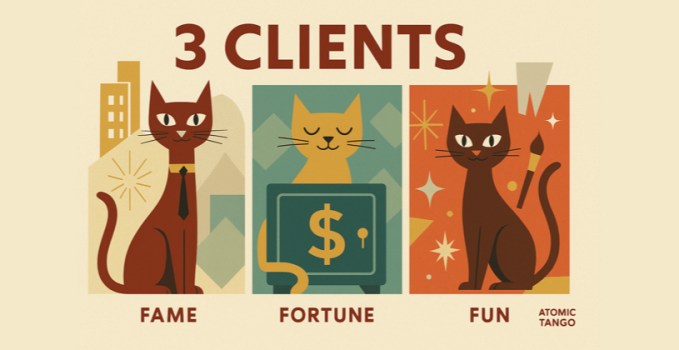
Polygamy also means you don’t need any single client to be perfect. That works fine for agencies and professionals just starting out — you need jobs NOW and can’t wait. Just make sure you land a client in each of these 3 categories:
1. The Fame Client
This client is a famous brand even your parents would know. They could be a Fortune 500 corporation, a branch of the government, a university, or a celebrity.
- Upsides: Having them on your roster indicates that you’re trustworthy and your work is high quality; hence, these clients elevate your professional brand. In addition, the prestige client’s size and stability usually guarantees payment. (Just in case, make sure everyone signs a prenuptial.)
- Downsides: Since you’re starting out, they might expect you to work for a discount or even free for the “privilege” of working with them. They certainly have the negotiating power. The larger ones can also be terribly bureaucratic, taking their sweet time for approvals and even payment. Creatively, the more corporate clients might prefer conservative, even clichéd work. Even worse, they might order you around so that you feel more like a production tool than a professional.
- Recommendations: First, make sure they give you written permission to claim them as a client in all your media and even press releases. If they insist on keeping your relationship confidential, forget about it. The whole point of the fame client is show and tell. In terms of work, always present your best ideas to them, but ultimately do what they want. Just remember to save the rejected ideas to show others what you “would have done.” Once you complete the project, thank them, and request a raise (both financial and creative) for future projects. If they demur, bid them a fare thee well. Hopefully, you already leveraged this prestige relationship to land another one.
2. The Fortune Client
This client helps you pay the bills… and that’s pretty much it. Unless you started with lots of funding, that might be all that matters. Pure cash-flow clients do not confer prestige and they don’t appreciate creativity. Indeed, they might have an “idea” — one so banal you’ll need a martini or three just to listen to it — and just want you to execute it. They could come from any industry, but most likely hail from conservative ones like finance, healthcare, education, and business-to-business services.
- Upsides: You don’t have to take a side job making those martinis for others. In fact, think of these clients as paying you to practice presentations and account management. Fortune clients also enable you to take on low-paying fame and fun clients; to hire professionals for non-creative work like accounting; and to afford slick outfits and dinners that will impress better prospects.
- Downsides: Working for fortune clients can feel like, well, work. That might compel your best creative talent to leave in boredom and frustration. Even worse, you won’t have any work that wins awards or helps you land future clients. The fortune-only clients might even drive you from the business altogether for something more exciting, like making martinis.
- Recommendations: Fortune clients are inevitable — even big agencies have them. Just don’t emotionally invest in them. The time and energy spent will not pay off; you’ll just burn out. Rather, quickly diagnose whether this client is good for money only, then delegate the work to a junior staffer or freelancer. Save your energy for fun clients or a side-project that shows off your talent, like that novel you’ve always dreamed of writing.
3. The Fun Client
By far the hardest to find and land, the fun client encourages you to do the imaginative work you fantasized about back in school while you were watching Mad Men and salivating over Nike ads. Note that “fun” here does not necessarily mean “funny”; this could be serious work that you find emotionally rewarding. Most fun clients hail from business-to-consumer industries, and tend to be led by large personalities, not committees. So think charismatic CEOs and NON-TECH entrepreneurs (most tech companies numbingly think their products don’t need creativity to sell). One common option that agencies seek out: a charity that you’ll help pro bono in exchange for creative freedom.
- Upsides: You’ll create work that looks great in your portfolio, that might go viral, even win awards. That leads to more clients and bigger paychecks, and attracts top talent to work with you. Above all, you’ll love your job.
- Downsides: They don’t necessarily pay well. And in the case of charities, you’ll work for free. In some cases, their appetite might exceed their budget, so they’ll excitedly buy your ideas then underfund the execution, resulting in work you can’t show anyone.
- Recommendations: Don’t blow this opportunity by submitting half-baked ideas or doing mediocre work. At the same time, don’t get self-indulgent: your responsibility is to grow their business, not use their money to create a short film with your favorite celebrity. So while eyeing awards, keep your client’s business goals in mind (such as sales) and measure your impact. That can help turn your fun client into one who is also famous and lucrative.
Keep Looking
Whenever you meet a prospect, quickly evaluate which category (or categories) they fall into. If they fall into “none of the above,” the choice is easy: run away. A relationship with anyone who’s not prestigious, pays poorly, and doesn’t let you use your brain is an abusive one. They’ll leave you too drained to pitch the good clients — which might be a moot point, since you won’t have any killer work to attract them in the first place. Never let desperation force you to settle. Ditch ’em and keep looking.
With luck and perseverance, you’ll find a client that combines two of the categories. Of course, the ideal client combines all three — if you find one, marry them immediately — but you’ll need to be very lucky (or connected) to find The One when you’re just starting out.
Quoth Steve Jobs (a tech entrepreneur who actually celebrated creativity), “The only way to do great work is to love what you do. If you haven’t found it yet, keep looking. Don’t settle. As with all matters of the heart, you’ll know when you find it.”
Discover more from Atomic Tango
Subscribe to get the latest posts sent to your email.